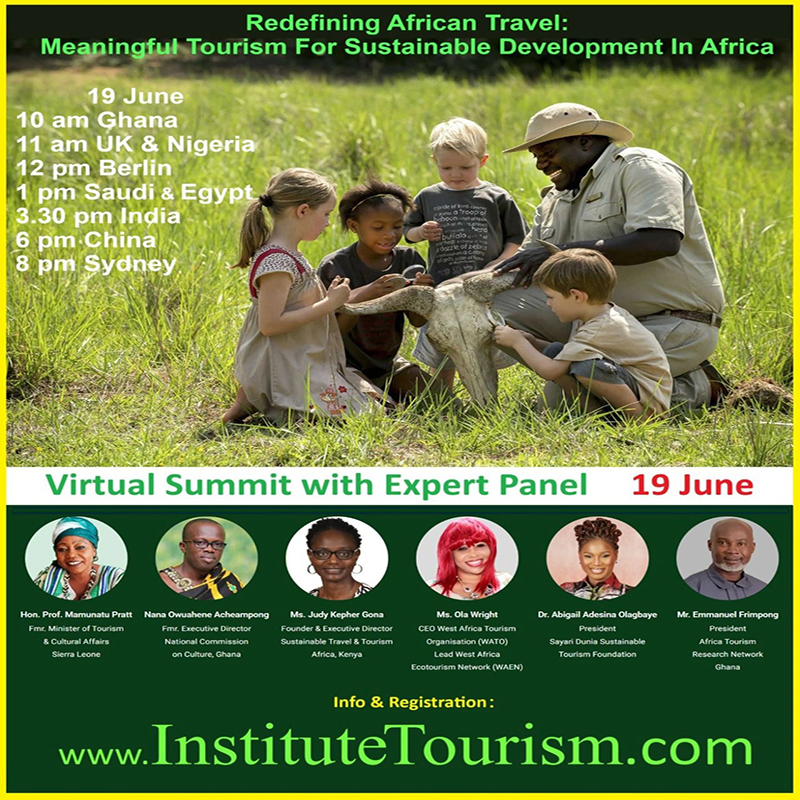
On the 19th June, 2025, the Meaningful Tourism Centre, the Africa Tourism Research Network and the Institute for Tourism held a very successful webinar about Meaningful Tourism for Africa.
The first part included welcoming remarks of the Chair Emmanuel Frimpong, founder of the Africa Tourism Research Network and an introduction into Meaningful Tourism by the founder of MTC, Prof. Dr. Arlt. The first exclusive content contained in short presentations by most of the seven Meaningful Tourism trainers in Africa, based in Ghana, Namibia, South Africa, Malawi, Zimbabwe, Tanzania & Zanzibar, Madagascar, Reunion & Mauritius. Some of them had got their certification just one day before the webinar, but all showed their enthusiasm to help the development of Africa’s sustainable tourism.
The main part consisted of five fascinating presentations giving a solid base for the future upgrading of tourism in Africa to a Meaningful Tourism strategy and action.
Judy Kepher Gona, Director of Sustainable Travel and Tourism Africa (Kenya) look at the history of sustainable tourism in Africa and especially Community-Based Tourism and Local Empowerment in great detail. After painting the great picture, Nana Otuo Awoahene Acheampong, Former Executive Director, National Commission on Culture in Ghana and Nkabom Henry of Kumasi Traditional Area emphasised the importance of Cultural Preservation and Authenticity. His conclusion: “Cultural preservation and authenticity are not just about protecting the past. They are about maintaining the unique identities of African communities while creating meaningful, responsible tourism that benefits both visitors and locals. A sustainable approach to tourism recognizes the importance of local voices, supports traditional livelihoods, and ensures that cultural assets remain vibrant for generations to come.”
Youth and Women in Meaningful Tourism was the topic of the Hon. Prof. Mamunatu Pratt, former Minister of Tourism and Affairs (Sierra Leone). Even though she was at a conference of her party, she still took the time out to share her insights into the key points and challenges of tourism development in Africa.
Ola Wright, the CEO West Africa Eco-Tourism Network (UK/Nigeria) concentrated in her presentation on Eco-Tourism and Environmental Responsibility, illustrating the Eco-Tourism needs to be an integral part of Meaningful Tourism.
Finally, the last speaker Dr. Abigail Adesina Olagbaye, President of the Sayari Dunia Sustainable Tourism Foundation, concentrated on Technology, Innovation and Digital Tourism for Africa’s Sustainable Development. She asked “How Can Africa Prepare for the Future of Technology, Innovation and Digital Tourism Meaningfully?
Her answer was summarized in a table:
As usual, the webinar was running overtime, so that there was only a limited amount of time for the Q&A section.
In a brief summary, Prof. Dr. Arlt thanked all speakers and also all viewers and made clear that this webinar can only be the first step on the road to Meaningful Tourism. The webinar showed that even among experts the concept of Meaningful Tourism (with a capital “M”) still needs to be understood in more detail and clarity.